Can You Change the Past? Novikov's Self-Consistency Principle
A time traveler is told not to change the past. But even breathing moves air molecules. How could visiting the past possibly leave it untouched?
The familiar instruction to time travelers—do not change anything—becomes puzzling as soon as we take it literally. Breathing changes the air. Standing in a room changes the light, the temperature, and the motion of the people walking around you. There is no obvious physical boundary between an insignificant disturbance and one that changes someone’s life.
Novikov’s self-consistency principle offers a different way to think about the problem. If travel into the past is possible, the traveler’s actions must fit into one consistent history. The breathing, the conversation, and the intervention were already part of what happened. There is no earlier version of history in which the traveler was absent, followed by a revised version in which the traveler arrived.
That sounds like a rule for writing science fiction. It is also a serious proposal about how to formulate physics in a spacetime where causes can loop back on themselves. Its mathematical content is easiest to see by separating three questions: what the local laws allow, whether their solutions fit together globally, and whether that fit is unique.
How a science-fiction problem became a physics problem
In general relativity, spacetime geometry determines which paths a physical observer can follow. A closed timelike curve, or CTC, is a path that always points toward the traveler’s local future but eventually returns to its starting spacetime event. A clock carried along the path keeps advancing; the difficulty appears when we try to order the entire path from an outside perspective.
This possibility did not originate with Novikov. Gödel’s 1949 rotating-universe solution showed that Einstein’s equations admit geometries containing CTCs.
Science fiction did help stimulate a later, more concrete research program. Carl Sagan’s work on Contact prompted discussions with Kip Thorne about interstellar travel through wormholes, reflected in Morris and Thorne’s 1988 paper on traversable wormholes. A wormhole is a hypothetical connection between regions of spacetime whose route through the connection can be much shorter than the outside route.
Morris, Thorne, and Yurtsever then argued that, if a traversable wormhole could be created and maintained, a time offset between its mouths could turn it into a time machine. Differential aging of the mouths supplies the basic idea: entering one mouth can lead to an exit that external clocks label as earlier. Their 1988 time-machine paper turned a question about shortcuts through space into a question about causality.
Novikov discussed the need for consistent histories in his 1989 analysis of a time machine. Friedman, Morris, Novikov, Echeverria, Klinkhammer, Thorne, and Yurtsever gave an explicit global formulation in 1990. Their question was whether familiar local laws could still fit together when spacetime allowed a return to the past.
Local laws, global histories
For readers comfortable with a little notation, a smooth closed timelike curve can be written as a path \(\gamma(\tau)\) satisfying
\[\gamma(0)=\gamma(T),\qquad T>0,\]with a future-directed tangent obeying
\[g_{\mu\nu}\dot\gamma^\mu\dot\gamma^\nu<0.\]Here \(g_{\mu\nu}\) is the spacetime metric, we use the sign convention \((-,+,+,+)\), and a dot means differentiation along the path. The inequality says that the path is timelike: locally it is an allowed path for a massive observer. The equality says that the path closes.
Ordinary equations of motion are local. They tell a ball how to accelerate or a field how to vary in a small neighborhood. Novikov’s requirement is global: the pieces must describe the same physical state wherever the geometry makes them meet again.
For example, take a fixed spacetime \(M\) with metric \(g\) and a real, massless scalar field \(\phi\) obeying
\[\Box_g\phi=0,\]where \(\Box_g\) is the wave operator in that geometry. Suppose we have specified a local solution \(\phi_U\) on a region \(U\). The consistency requirement is that there exist a sufficiently regular, single-valued field on the whole nonsingular spacetime such that
\[\begin{cases} \Box_g\phi=0 & \text{throughout }M,\\ \phi|_U=\phi_U. & \end{cases}\]The second line means that the global field agrees with the local field we started with. This expresses the global-extension principle for a field in a prescribed spacetime geometry.
Neither the existence nor the uniqueness of such an extension is guaranteed by this statement.
History as a fixed point
There is a useful way to make the global condition more concrete. Imagine cutting a causal loop at the exit of a wormhole. Specify the state emerging there: its arrival time, position, velocity, and whatever other variables the model requires. Call that state \(x\).
Hold the external incoming data fixed. Let the system evolve, including any interactions with its younger self, until it enters the wormhole. Apply the wormhole’s rule for transporting that state back to the exit. When this construction defines a return map \(F\), consistency requires
\[\boxed{x=F(x).}\]The state we assumed would emerge must equal the state the resulting history actually sends back. For a field, \(x\) might be an entire function rather than a short vector. For more complicated dynamics, a system of matching equations can be more appropriate than a single-valued map. The underlying requirement is the same.
A bit sent into the past shows why existence and uniqueness must be kept separate. Let \(x\in\{0,1\}\) be the received bit, and let a device send \(F(x)\) back to that same receiving event.
| Device rule | Consistency equation | Allowed histories |
|---|---|---|
| Copy the bit | \(x=x\) | Both 0 and 1 |
| Always send 0 | \(x=0\) | Only 0 |
| Flip the bit | \(x=1-x\) | Neither 0 nor 1 |
The last row is a contradiction within the stipulated classical model. The solution \(x=1/2\) is unavailable because a classical bit is either 0 or 1. Assigning equal probabilities to the two values does not make an individual history satisfy the equation.
Novikov’s principle excludes the complete, perfectly functioning bit-flipping loop as described.
A billiard ball meets its younger self
The classic physical puzzle replaces a would-be murderer of their own grandfather with a billiard ball. Send a ball toward a wormhole that returns it to an earlier time. Arrange the geometry so that the older ball appears to knock the younger ball away from the entrance. Then the younger ball never enters, so the older ball cannot emerge to deliver the collision.
The tempting mistake is to combine pieces from incompatible trajectories: use the collision-free path to determine the older ball’s arrival, then add a collision that destroys the path which produced it. A valid solution must determine the arrival and collision together.
Echeverria, Klinkhammer, and Thorne’s 1991 billiard-ball paper did just that. For a broad class of apparently dangerous incoming trajectories, they found infinitely many self-consistent solutions.
We can check one self-consistent collision explicitly without reproducing their full geometry. The following construction is an elementary illustration, with a prescribed wormhole connection and Newtonian motion outside it.
An exactly solvable loop
Represent the ball in a plane as a perfectly elastic, frictionless disk with radius \(1/\sqrt2\) and mass \(m\). Choose units in which its nonrelativistic speed is 1. The wormhole connects an entrance at \(B=(0,-2)\) to an exit at \(A=(1,3)\). Our idealized boundary rule maps the disk’s center at \(B\) to \(A\), four time units earlier, preserving its velocity. We neglect the thickness and transit duration of the connection and any forces away from collisions.
At external time \(t=0\), let the younger disk have center \((0,0)\) and velocity \((1,0)\). Let its older version have center \((1,1)\) and velocity \((0,-1)\). Their centers are \(\sqrt2\) apart, exactly the sum of their radii, so they are touching.
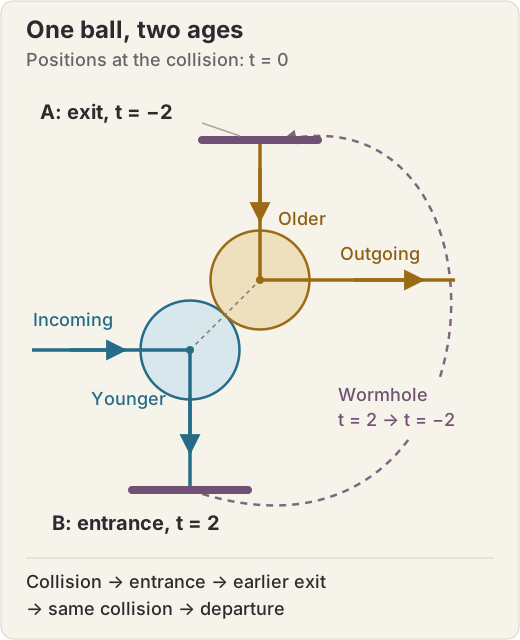
The elastic collision exchanges these two velocities. The younger disk turns downward; the older disk turns right. Now follow the younger disk along its own journey:
- It collides at \(t=0\) and travels down from \((0,0)\) to \(B=(0,-2)\), arriving at \(t=2\).
- The wormhole takes it from \(t=2\) to \(t=-2\) at \(A=(1,3)\), still moving downward.
- It travels down for two time units and reaches \((1,1)\) at \(t=0\), supplying precisely the older disk assumed in the collision.
- After striking its younger self, it moves to the right and leaves the scene.
Everything matches: position, time, velocity, and the collision law. The impact causes the trip that supplies the impact.
Check the collision and the full trajectory
Write the incoming velocities as \(u=(1,0)\) for the younger disk and \(v=(0,-1)\) for the older disk. The unit vector from the younger center to the older center is
\[n=\frac{(1,1)}{\sqrt2}.\]For frictionless disks, the impulse acts along \(n\). For equal masses and a perfectly elastic collision, conservation of momentum and reversal of the relative normal velocity give
\[\begin{aligned} u'&=u-[(u-v)\cdot n]n,\\ v'&=v+[(u-v)\cdot n]n. \end{aligned}\]To derive this, write the impulse on the older disk as \(Jn\) and that on the younger disk as \(-Jn\). Then \(u'=u-(J/m)n\) and \(v'=v+(J/m)n\). The restitution condition
\[(u'-v')\cdot n=-(u-v)\cdot n\]implies \(J/m=(u-v)\cdot n\), yielding the displayed formulas. Here \((u-v)\cdot n=\sqrt2\), so
\[\begin{aligned} u'&=(1,0)-(1,1)=(0,-1),\\ v'&=(0,-1)+(1,1)=(1,0). \end{aligned}\]Total momentum is \(m(1,-1)\) before and after the impact. Total kinetic energy is \(m\) before and after it, because both speeds remain 1.
The younger center follows
\[q_{\mathrm{young}}(t)= \begin{cases} (t,0),&t\leq0,\\ (0,-t),&0\leq t\leq2. \end{cases}\]The older center follows
\[q_{\mathrm{old}}(t)= \begin{cases} (1,1-t),&-2\leq t\leq0,\\ (1+t,1),&t\geq0. \end{cases}\]The endpoint and velocity matching conditions are exactly the stipulated wormhole rule:
\[\begin{aligned} (q_{\mathrm{young}}(2),\dot q_{\mathrm{young}}(2^-)) &=((0,-2),(0,-1)),\\ (q_{\mathrm{old}}(-2),\dot q_{\mathrm{old}}(-2^+)) &=((1,3),(0,-1)). \end{aligned}\]There is no hidden extra collision. For \(-2\leq t\leq2\), when both versions exist, the distance between their centers is
\[\lVert q_{\mathrm{old}}(t)-q_{\mathrm{young}}(t)\rVert =\sqrt2(1+|t|).\]It equals the sum of the radii only at \(t=0\) and is strictly larger otherwise. The two versions approach before the collision and separate afterward. This verifies the entire proposed trajectory within the idealized model.
This particular construction also has a second solution for the same incoming path: the ball can simply continue along \((t,0)\) forever, miss both mouths, and never encounter an older version. Thus even this small example demonstrates nonuniqueness. The incoming motion by itself does not tell us which globally consistent history occurs. It is a simpler illustration than the original paradoxical setup, where the unperturbed path enters the wormhole.
What about breathing, chaos, and free will?
Return to the traveler who disturbs the air. In a self-consistent history, those disturbances belong to the physical state being solved for. The principle has no exemption for small changes and no special prohibition reserved for large ones. What matters is whether the whole account is compatible with itself.
Chaos makes nearby initial conditions produce very different later outcomes. That can make finding or predicting consistent histories difficult. It does not imply that a history must repair itself after a perturbation, or that every possible intervention admits a consistent completion.
The distinction is between two claims:
- A realized history must be consistent with the interactions it contains.
- A realized history must remain unchanged under every imaginable replacement of those interactions.
Only the first expresses the consistency requirement. Changing a device, a decision rule, or an incoming state changes the mathematical problem. The new problem may have different solutions or no solution under the stipulated assumptions.
Your actions can still have causes and consequences. The ball’s collision is indispensable to its looping trajectory. Likewise, a traveler’s warning might be the reason someone survives; it must then belong to the history in which that person survived. Whether such a picture allows the kind of free will we care about is a further philosophical question. The consistency equation alone does not settle it.
Who wrote the proof?
Suppose your older self hands you a beautiful mathematical proof. You check every step, keep a copy, and eventually travel back to give it to your younger self. You learned it by reading it, and your older self remembered it because you had read it. Nobody independently worked it out. This is a bootstrap loop: information circulates through a chain of causes with no act of invention at its beginning.
The physical age of the paper leaves this puzzle untouched. You can copy the proof onto fresh paper before taking it back; the text is what circulates. The question is why that particular argument exists in the history at all.
There are two levels of explanation here. We can explain each person’s possession of the proof by pointing to a transmission elsewhere in the loop. But following those transmissions brings us back to where we started, without identifying an independent source of the content. An explanation of each link can leave a question about the whole chain unanswered.
The fixed-point formulation makes the gap precise. Encode the text as a string \(x\) of \(n\) bits. If the entire operation is faithful copying, its return map is
\[F(x)=x,\qquad x\in\{0,1\}^n.\]Every one of the \(2^n\) strings is a fixed point. A brilliant proof, a shopping list, and meaningless symbols all satisfy the same consistency condition. The copying rule preserves content; it supplies no reason for one content rather than another. Requiring the text to be a valid proof would restrict the candidates, but that is an additional condition. The consistency requirement by itself also supplies no probabilities over the candidates.
Checking the proof does answer a different question: why should we believe the theorem? Its logical steps can justify the conclusion regardless of how we acquired the text. The puzzling absence is an independent discovery of those steps. Logical justification, causal transmission, and historical invention come apart.
Further dynamics or boundary conditions might select a particular text. For example, if the traveler independently derives a proof before sending it back, that derivation contributes an explanation of its content. In the pure copying story, however, treating the realized text as part of the global history leaves its selection unexplained by the copying dynamics. This resembles the familiar need to supplement equations of motion with data, although here the unspecified information is distributed around a causal loop.
David Lewis addressed this issue in The Paradoxes of Time Travel (1976), pp. 148–149. He allowed that events within a loop can have causal explanations while the loop as a whole remains unexplained. His response was to accept that as a possible brute fact, much as explanations elsewhere eventually reach facts taken as given. This is a philosophical position about where explanation may end. Someone who requires information to have an origin outside its own transmission cycle will find it unsatisfying.
Novikov’s principle therefore leaves the explanatory puzzle open. It tells us how the proof’s appearances must agree with one another. In a pure bootstrap loop, the answer to “Who first discovered it?” is “No one”; the question “Why this proof?” still calls for something beyond self-consistency.
The idea in fiction—and fiction in the idea
Fixed-history stories existed before the modern physics literature, so resemblance alone is not evidence that a writer borrowed from Novikov. The more interesting relationship runs in both directions: fiction supplies questions, physics sharpens them, and fiction explores what the answers might mean for a person.
There is a particularly clear example in Ted Chiang’s The Merchant and the Alchemist’s Gate. In a 2019 interview, Chiang explicitly identifies Thorne’s discussion of the billiard-ball time machine as an inspiration. He wanted to explore a fixed past without making the result inevitably despairing. Understanding, regret, and reconciliation can change even when the events being understood cannot.
Several stories explore the human consequences of this structure:
| Work | Connection to self-consistency |
|---|---|
| La Jetée and Twelve Monkeys | Memory and later experience fit into a single causal history. The latter’s production notes explicitly trace its inspiration to the former. The tension is discovering how the pieces fit. |
| All You Zombies and Predestination | Personal identity becomes entangled with causal loops. The film adapts Heinlein’s story. The bootstrap question becomes a question about a person’s own origin. |
| Los cronocrímenes (Timecrimes) | Attempts to escape a predicament help produce it. Its distributor’s account emphasizes the protagonist’s increasing involvement in the events he tries to fix. |
| Dark | Interlocking generations and encounters across time make causal loops central to its mystery. Its later use of multiple worlds complicates a strict single-history reading. Series page. |
| The Merchant and the Alchemist’s Gate | Visiting the past changes the traveler’s understanding of it. The scientific connection is documented by Chiang’s own account, and the emotional possibilities extend beyond fatalism. |
Stories about rewriting a timeline or moving between alternative histories ask a different question. If a traveler prevents an event in another branch while the original branch still exists, the story has changed the relationship between the histories.
The appeal of the fixed-history story is that a familiar scene can acquire a new explanation without any of its events being replaced. The audience experiences a revision in knowledge rather than a revision in the world. There is a thematic connection to the forty cheating husbands puzzle: what someone can infer changes even when an underlying fact was already true. The mechanisms are different—public information in one case, causal loops in the other—but both reward asking what was known, as distinct from what happened.
Must causal loops be consistent—or absent?
Novikov’s proposal asks how histories must fit together if backward time travel is available. Hawking’s chronology protection conjecture instead proposes that physical laws prevent the formation of closed timelike curves. His work investigates whether quantum effects and their gravitational backreaction obstruct the creation of a time machine. The two proposals address different questions: Novikov constrains the histories within a spacetime containing causal loops; chronology protection concerns whether such loops can form.
The original breathing question therefore has a precise answer within Novikov’s picture. A traveler does interact with the past, down to the air molecules. Those interactions must belong to the same history that contains the journey. The mathematical task is to find a complete history in which the departure, arrival, and consequences all agree.
Further reading
- David Lewis (1976), The Paradoxes of Time Travel. Causal loops, the origins of information, and the distinction between explaining each event and explaining a whole history.
- Michael S. Morris and Kip S. Thorne (1988), Wormholes in spacetime and their use for interstellar travel: A tool for teaching general relativity. The traversable-wormhole framework and its connection to Contact.
- Michael S. Morris, Kip S. Thorne, and Ulvi Yurtsever (1988), Wormholes, Time Machines, and the Weak Energy Condition. The conditional conversion of a traversable wormhole into a time machine.
- Igor D. Novikov (1989), An analysis of the operation of a time machine. An early discussion of global consistency and restrictions on initial data.
- John Friedman and coauthors (1990), Cauchy problem in spacetimes with closed timelike curves. The global principle and model field equations.
- Fernando Echeverria, Gunnar Klinkhammer, and Kip S. Thorne (1991), Billiard balls in wormhole spacetimes with closed timelike curves: Classical theory. Consistent self-collisions and the failure of uniqueness.
- Stephen W. Hawking (1992), Chronology protection conjecture. The possibility that physics prevents time machines from forming.